Core concepts
What Querywright does not do automatically
Querywright records, measures, observes and checks. Publishing, outreach, reasoning and every decision stay with you and your AI, by design.
Querywright is the operating layer your AI works through: it scans your site, measures search demand, observes Google, keeps every record and runs mechanical checks. It does not act on your site, on Google or on other people. Knowing where it stops tells you what is still yours to do.
What Querywright does not do
| Querywright does not | What happens instead |
|---|---|
| Publish or deploy anything. There is no CMS connection. | You publish the copy you accepted. Afterwards your AI can scan the live page and compare it with that copy. See live comparison. |
| Manage Google Business Profiles. | It observes local packs and business listings in Google’s results. You say which listing is yours. See Local SEO. |
| Send outreach. | It shows who links to you and to competitors as dated facts. You decide which sources to pursue, and any contact is yours. See links. |
| Model attribution or prove causation. | It shows dated observations in order. A sequence is not a cause; see evidence vs your AI’s judgment. |
| Approve, accept or confirm anything on its own. | Every decision waits for your explicit word, given to your AI. See your decisions. |
| Run an AI model. | Your AI, Claude or ChatGPT, does the reasoning and the writing. Querywright stores your AI’s rationale labelled as its judgment. |
| Use an included allowance without asking. | Your AI asks before any request that uses allowance, and an Investigate button in the App states the units it will use and waits for you to confirm. See when your AI asks first. |
| Change anything in your Google accounts. | It reads Search Console and Google Analytics with read-only access. It does not request indexing or edit properties. |
| Choose your searches or pages. | It lists candidates from your evidence. Your AI suggests a plan; you approve it. |
| Score pages, competitors or links. | It shows counts, positions and dates, never a Querywright score. Whether a competitor is strong is your AI’s read. |
| Guarantee rankings or traffic. | It observes what Google does after you publish, once you enroll rank tracking. |
| Audit your whole site. | A scan reads up to 200 pages and reports exactly what it read and what it did not. |
| Start rank tracking by itself. | Weekly checks begin only when you enroll them. |
Why it works this way
Each boundary keeps a record honest. If Querywright published, it could not tell you whether the published page matched what you approved. If it ran its own model, its recommendations would sit in the record beside the facts. If it approved on its own, an approval would no longer mean you chose. Because it does none of these, a plan in History is one you approved, a measurement is a measurement, and a check describes the copy you accepted.
Where it shows in the App
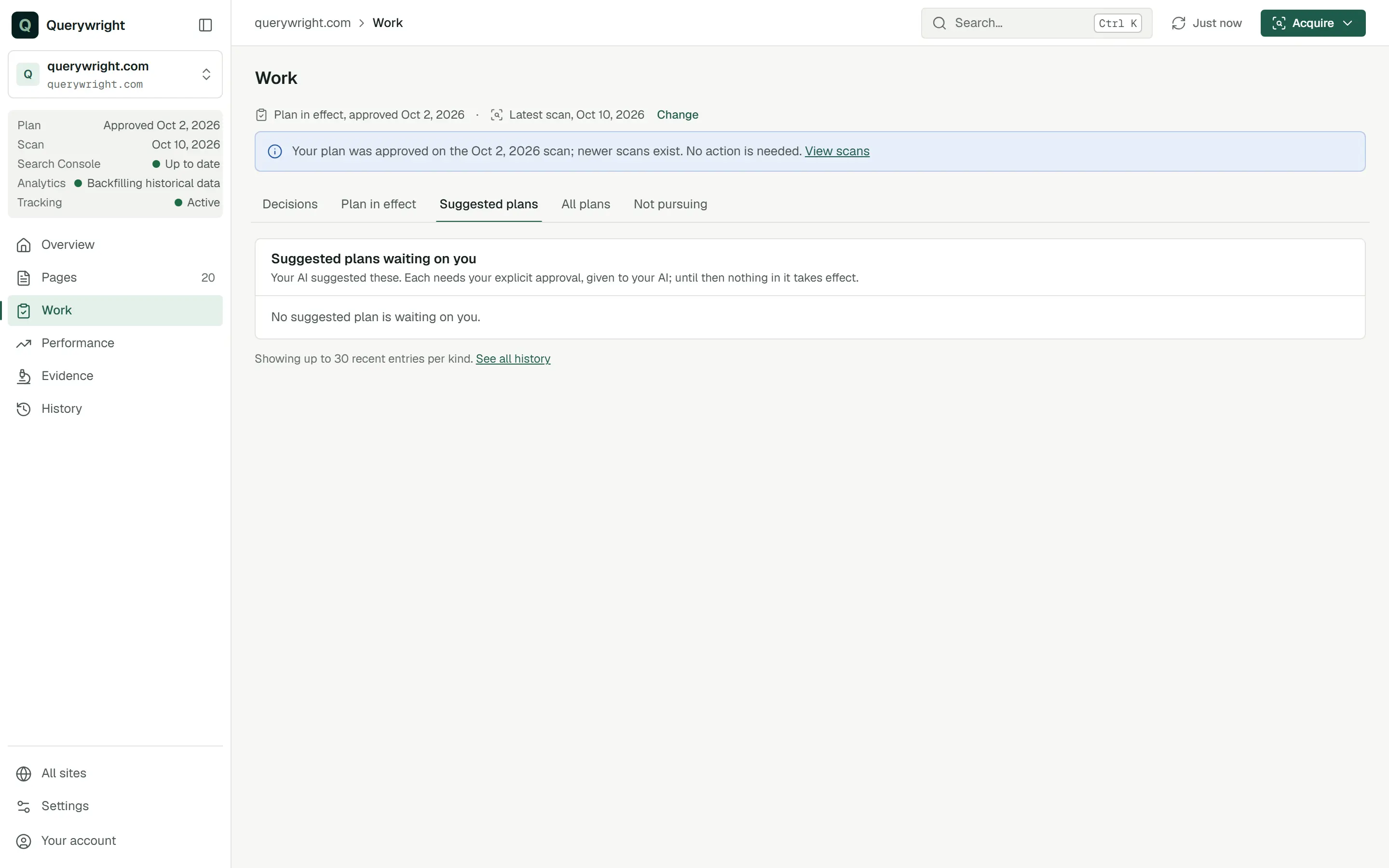
The App’s own wording carries these boundaries. Work › Suggested plans says “Each needs your explicit approval, given to your AI; until then nothing in it takes effect.” Performance › Analytics says “Changes show what happened, not why.” Evidence › Links says a domain linking to a competitor “is a fact, not a recommendation”. Settings → Usage describes allowances as “included allowances, not charges”.
Does it use allowance?
This page describes what Querywright does not do, so nothing here uses allowance. For what does, see allowances and pricing.
Last updated