Research
Google results
Before your AI suggests which page should own a search, it can check what Google actually showed for that search, where and when. The observation is kept exactly; what it means is your AI's reading.
A Google results observation is a saved record of what Google’s results contained for one exact search, at one moment: the organic results in order through the top 50, observed on desktop or on mobile, in a named location and language. Search demand says how often a search is made. A Google results observation says who appeared for it.
What Querywright records
| Field | Meaning |
|---|---|
| Context | The search as submitted and as normalized, the location (a city, county, region or country), the language, Google, the device (desktop or mobile) and a depth of 50. |
| Observed | When the results were observed. A reused observation keeps its original time; it is never refreshed in place. |
| Organic results | The organic results in order, each with its position, address, hostname and title. Nothing is added and nothing is scored. |
| Counts | How many items Google returned, how many organic results were kept, and how many distinct domains they came from. |
| Other features | The featured snippet, if there was one, how many paid results appeared, and which other features were present, such as a local pack. |
| Rewrites | If Google corrected the spelling or rewrote the search, that is recorded as Google’s own fact. |
Depth 50 means up to five pages of results. Features such as a local pack or a featured snippet take positions too, so a full observation can hold fewer than 50 organic results. Desktop and mobile are separate observations; desktop results do not tell you what mobile shows.
How your AI uses it
- Observe the shortlist. Once a set of searches is worth deciding about, your AI asks to observe Google’s results for them in one explicit location and language. It asks you first. Desktop is the default; it can observe mobile when you want to see it.
- Reuse what is fresh. If the same search was observed in the same context within the last 24 hours, Querywright returns that observation instead of a new one, and no allowance is used. If you want a new observation sooner, your AI can ask for one, though not within an hour of the last.
- Read it back exactly. Any saved observation can be read again later, in a new conversation, with the same rows in the same order. Reading never contacts Google.
- Ground the suggested plan. When your AI suggests which page should own a search, it can attach a desktop observation for each target search. The observation stays with the plan you approve, so you can see what Google showed on the day your AI recommended a direction. A plan without one is still valid.
A request for several searches can succeed for some and stop at one. Your AI tells you which completed and which did not, and it does not retry an uncertain request on its own. While the outcome of a request is unknown, its allowance is held until it settles; Settings → Usage lists it under “Held allowances”.
I want to rank for ‘emergency plumber annapolis’. Which of my existing pages should own it, or do we need a new page? Show me the search demand and the current Google results before you suggest a plan.Where it shows in the App
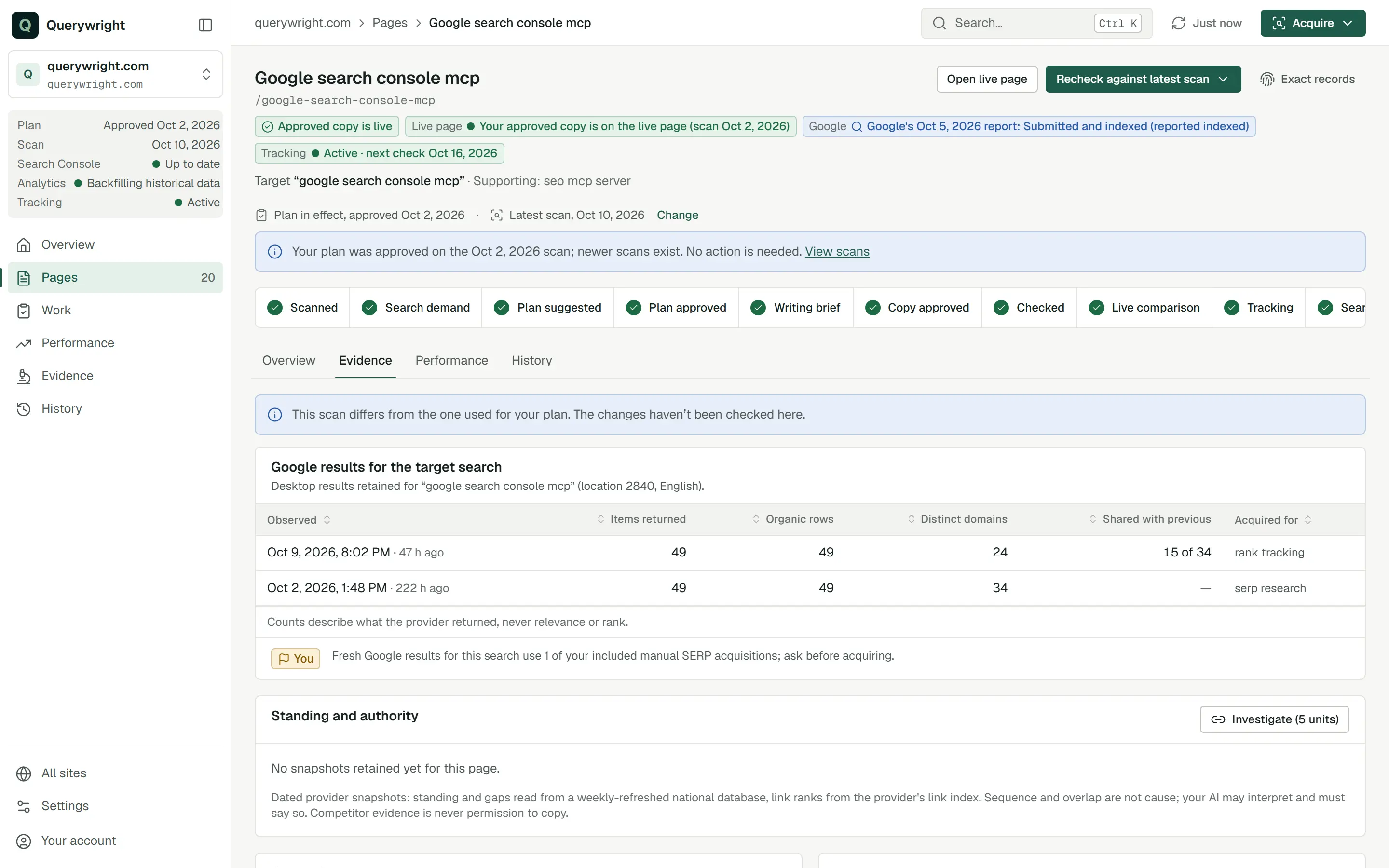
A page’s Evidence tab shows “Google results for the target search”: the desktop results saved for that page’s target search and market, each with when it was observed, how many items and organic rows came back, distinct domains, and how many domains it shares with the previous observation. The table notes “Counts describe what the provider returned, never relevance or rank.” Evidence › Competitors counts the domains in these results across your plan’s searches; see competitors.
After you publish
Rankings asks Google the same question every week for the searches in your plan, on desktop and on mobile as separate checks, in the location and language the demand was measured in. Each weekly check is recorded as a Google results observation of exactly this kind. Weekly checks use your included rank tracking allowance, not Manual Google results.
Does it use allowance?
- Manual Google results (500 per billing period): one for each new observation of one search on one device in one market.
- The same search in the same context within 24 hours is reused and uses nothing. Splitting a request into smaller ones does not change the count.
- Reading a saved observation uses nothing.
Your AI asks before using any. The counts are in Settings → Usage; see allowances.
Last updated