
SEO software for agencies that keeps the strategy alive after the handoff.

Querywright is SEO software for agencies and freelancers whose strategy has to survive more than one pair of hands. It keeps the evidence, the measured demand, the direction you approved, the copy you accepted, and what Google did afterwards in one record, so the reason behind a page is still there when the developer, the client, or your AI asks.

Built for freelancers and small agencies already doing SEO work with Claude or ChatGPT.

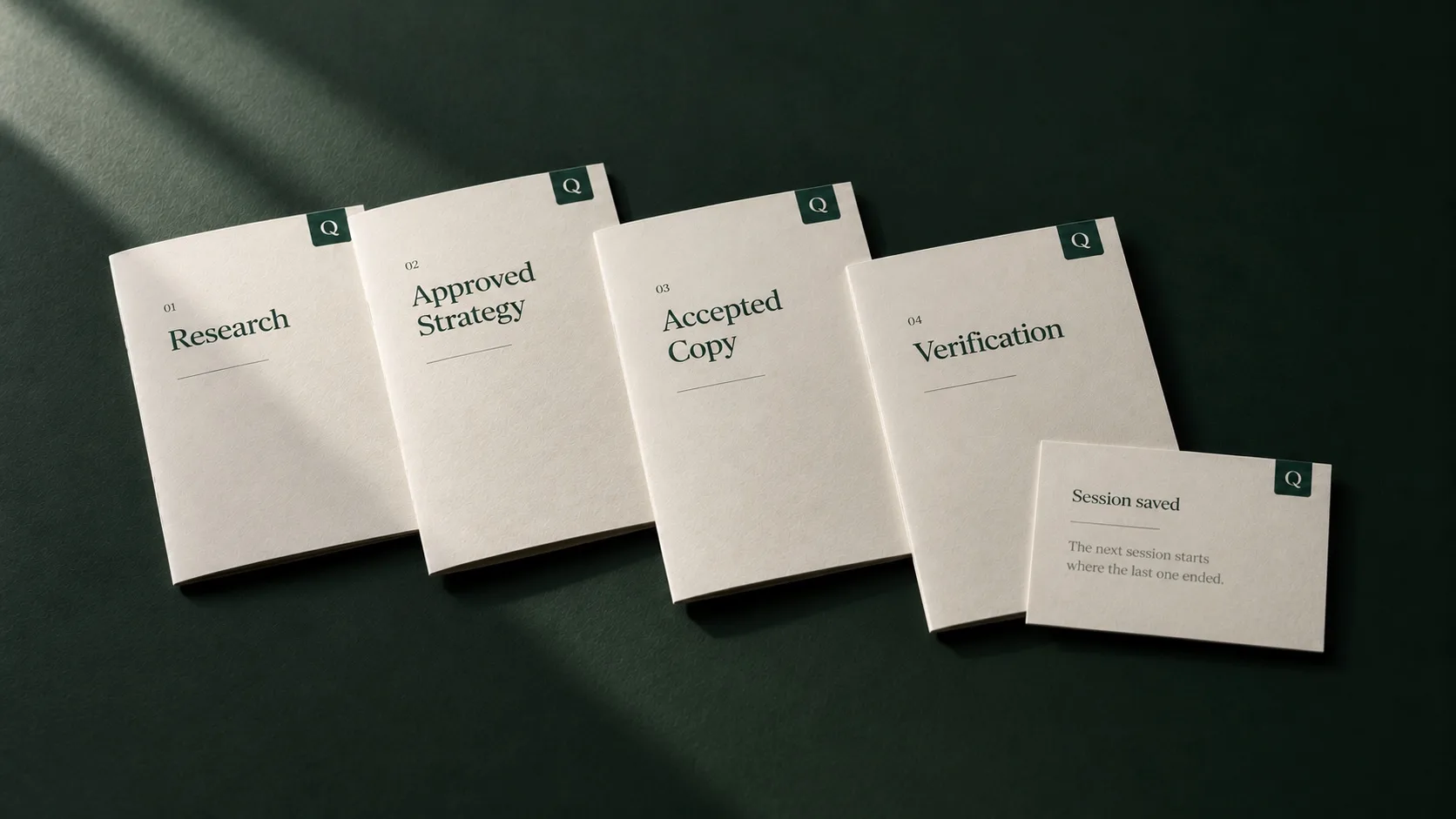
A clipped bundle of Querywright booklets: Research, Approved Strategy, and Accepted Copy, with a Verification card on top.

An agency strategy passes through more hands.

Research lives in one tool. The strategy lives in a document. The client approves a version of it in an email. The developer builds from a ticket. Then an AI writes copy from whatever it can see.

Every handoff gives the reason behind a decision another chance to disappear. Six months later the client asks why a page exists, and nobody can prove the answer anymore.

Five booklets in a row, numbered 01 to 05: Research, Strategy, Client, Developer, AI.

Keep your SEO tools for agencies. Add the part between them.

Semrush, Ahrefs, DataForSEO and other SEO tools give you keyword, ranking, SERP, backlink and competitive data. Claude and ChatGPT can reason about that data and write the page. Querywright keeps what happens between them connected: the evidence, the direction you approved, the exact copy you accepted, the verification, and the outcome history.

Querywright is not a replacement for a full SEO suite. It is the evidence and workflow layer around the AI doing the work.

Five labels, kept apart.

Querywright labels each fact by where it came from, so a guess never quietly becomes the source of truth.

  1. Observed.Querywright saw this on the site.
  2. Measured.A provider measured this.
  3. Reasoned.Your AI concluded this.
  4. Approved.You chose this direction.
  5. Verified.The accepted work was checked against the approved plan.

For an agency, the label that matters most is Approved. The recommendation and the decision are kept as two different records, so “who approved this” has an answer: you did, for that exact proposal.

One chain, from research to results.

The stages are the same for every site. An SEO platform for agencies has one extra job: the record has to survive more hands.

  1. 01

    Research

    Querywright scans the public site and keeps what it actually observed, so you see what is there before anyone proposes changing it.

  2. 02

    Demand

    A provider measures search demand for a named market and language. Measured zero, no provider evidence, and unmeasured stay different things, and your AI cannot invent a number.

  3. 03

    Proposal

    Your AI proposes which page should own which search, with the reasoning in writing. That reasoning is labeled as your AI’s, not as evidence.

  4. 04

    Approval · You

    You approve the plan, ask for changes, or say no. Nothing becomes your plan until you say so.

  5. 05

    Brief

    Querywright issues an authenticated brief from the approved direction, the retained scan, the measurements, the uncertainty you approved, and the facts the copy must not invent.

  6. 06

    Write · You

    Your AI writes the page. You edit it, ask for revisions, or accept the exact version you are willing to publish. Approving the plan is not accepting the copy.

  7. 07

    Verify

    Before anything ships, your AI points each claim in the accepted copy at the evidence behind it, and Querywright checks those references. Where software cannot prove something, the result says it needs your judgment.

  8. 08

    Results

    Once the page is live and you enroll the site, Querywright tracks where the approved searches appear in Google desktop and mobile results, top 50, about once a week, and shows when another of your pages takes a search. Connect Search Console to add finalized clicks, impressions, CTR and average position.

What happened after you published, stated honestly.

Querywright keeps the approved direction attached to what Google observes afterwards: the search, the page you planned for it, and where your site appeared each week. It records what happened and does not claim the work caused it. If tracking started after the work was done, the starting point reads Unknown instead of a flattering baseline.

When a client asks what happened, you have a dated record of what was approved and what Google showed afterwards.

Built to work across your client sites.

Use Querywright across your client sites without managing a separate search-data bill. The Founding Beta includes ten unique researched site origins per billing period, with the search-data provider included. A site counts when its first scan succeeds, and rescanning it in the same period reuses the same slot. See pricing

Give your AI evidence it can reason from.

Keep the reasoning, keep the approval, keep the evidence, check the work before it ships, and see what happened after.

Join Founding Beta