Performance
Local SEO
Where your business shows in Google's local pack, observed one search, one location and one device at a time, and what each source says your name, address and phone are.
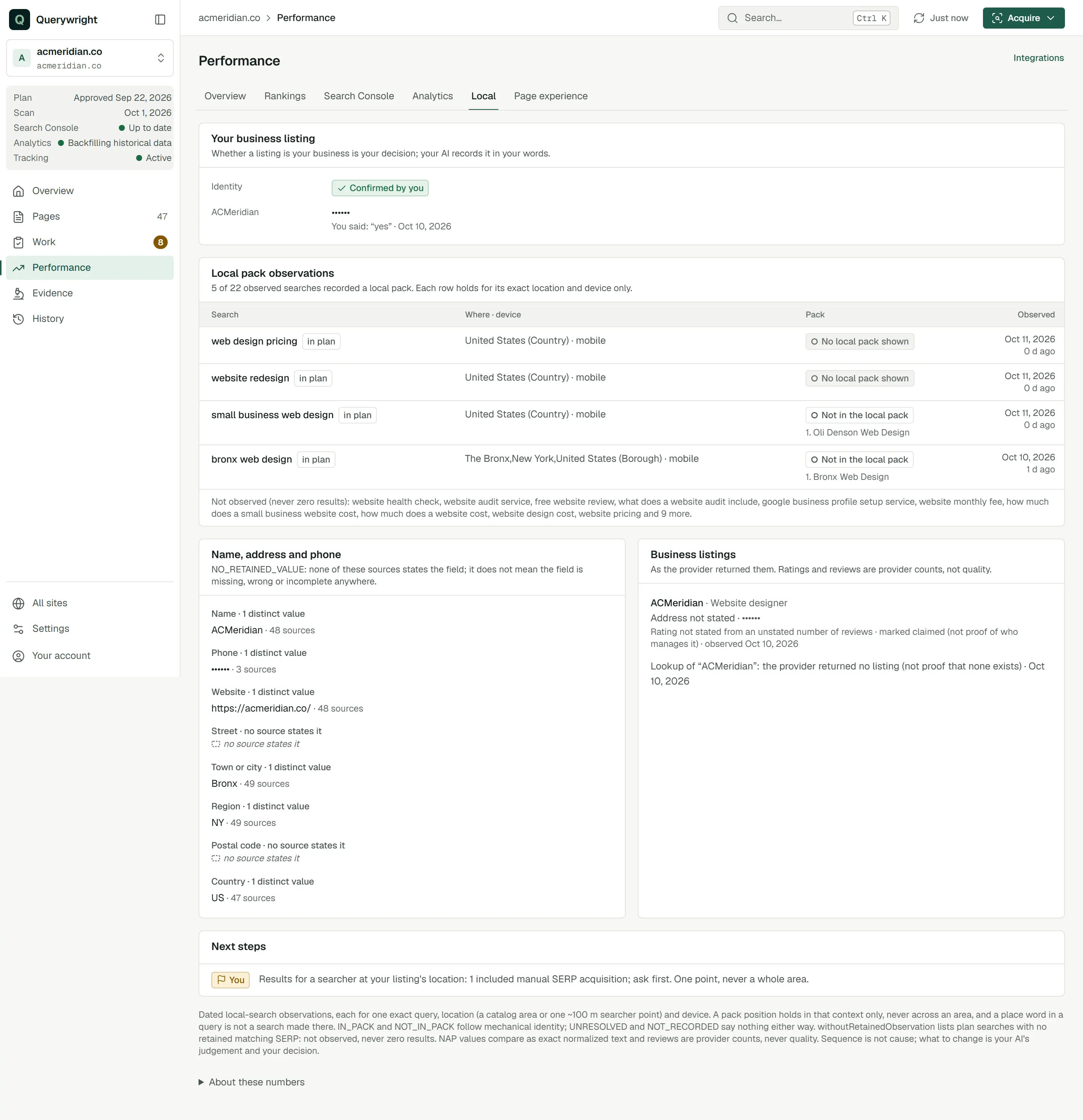
Local SEO evidence in Querywright is what Google’s results and public sources showed about your business locally. It has three parts: whether your business appeared in the local pack (the block of business listings Google shows for some searches) for an exact search, location and device; the business listings a provider returned; and your business’s name, address and phone exactly as each source states them. Your AI gathers this with your agreement. Querywright records it and does not manage your Google Business Profile.
What Querywright records
| Field | Meaning |
|---|---|
| Search | The exact search observed, marked “in plan” when it is a target search in your plan. |
| Where · device | One location (a named area such as a city, or a point with a radius of about 100 m) and one device. |
| Pack | What the observation found, with your position in the pack when you are in it, and the businesses at the top of the pack. See the table below. |
| Observed | The date of the observation and how many days ago it was. |
| Your business listing | Whether a listing is yours, and the listings seen in the evidence that could be. |
| Name, address and phone | Each part (name, phone, website, street, town or city, region, postal code, country) with every distinct value found and how many sources state it. Values are compared exactly, so “St” and “Street” count as different values. |
| Business listings | Listings as the provider returned them: name, category, address, phone, rating and number of reviews. |
| Local search demand | Search demand measured for local searches at a specific location. |
A pack position holds only for its exact search, location and device. Querywright never combines observations into a ranking “in” a city or an area. A place name inside a search is not a search made in that place, and a place with no observation was not measured.
Pack states
| Pack | What it means |
|---|---|
| “In the local pack” | A listing identified as yours was in the pack, with its position in that context. |
| “Not in the local pack” | A pack was shown and every listing in it is someone else’s, or you confirmed a listing and the pack did not contain it. |
| “No local pack shown” | Google showed no local pack for that search, location and device. |
| “Can’t tell (listing identity unresolved)” | A listing in the pack could be yours, but it is not settled whether it is. |
| “Pack not recorded” | The observation was made before Querywright recorded local packs. |
Searches with no observation are listed as “Not observed (never zero results)”.
Which listing is yours
Whether a listing is your business is your decision. Querywright identifies listings mechanically: by a listing you confirmed, or by the website a listing states matching your site’s domain. A matching name, phone or address alone never settles it. Tell your AI which listing is yours, or that none is, and it records your words.
| Identity | Meaning |
|---|---|
| “Confirmed by you” | You told your AI this listing is your business. Your words and the date are shown. |
| “You said none of these is yours” | You told your AI none of the candidate listings is your business. |
| “Needs your decision” | Candidate listings were seen and you have not said which, if any, is yours. |
Where does my business show in the local pack for ‘plumber near me’ in Glen Burnie, and is the listing you found actually mine?What it does not claim
Where it shows in the App
- Performance › Local holds your business listing, the local pack observations, name, address and phone by source, business listings, local search demand and next steps.
- Performance › Overview shows how many observations found you in a local pack, how many listings are saved and whether your listing is confirmed.
What you decide
Does it use allowance?
Yes, when your AI gathers new local evidence, and it asks first:
- A local pack is recorded with Google’s results for a search, which uses Manual Google results. Results for the same search, location and device under 24 hours old are reused. Weekly rank checks also record the local pack for your planned searches without using more.
- Looking up a business listing, or reading the name, address and phone a public page states, uses Site Intelligence units. The same lookup within 7 days is reused.
- Measuring local search demand uses Keyword measurements.
Reading what is already saved uses nothing. See allowances.
Last updated